We have seen this before.
In 2014, when the government launched the Jan Dhan Yojana, a lot of people dismissed it. Too ambitious. Too complex. India is not ready. And then, when UPI came along, certain politicians publicly laughed at it (search that clip from parliament on youtube). Who will use digital payments for a 10-rupee chai? Street vendors? Auto drivers? Come on.
Well, here we are.
India now processes the largest volume of real-time digital payments in the world. More than any other country. Not the US, not China. India. A country that, barely a decade ago, was still largely unbanked.
The same people who laughed at UPI are now using it every single day. That is the story of India’s fintech transformation. Every time a new infrastructure layer is built, people dismiss it. And then it quietly becomes the backbone of the economy.
Account Aggregators are that next layer.
Digital payments changed India. But it also created a new problem that nobody is talking about enough.
Money is now invisible. When you paid by cash, you felt it leave your hands. There was friction. That friction had a psychological function. It made you aware. Today, a tap on your phone and the money is gone. You don’t feel it. You don’t see it. And by the end of the month, you look at your bank account and wonder where it all went.
UPI made spending frictionless. That is a feature. But it is also, quietly, a bug.
Consumer spending in India is at an all-time high. Credit card defaults are rising. Buy Now Pay Later has become a debt trap for millions of young Indians who do not fully understand what they are signing up for. The fintech apps that sit on your phone – the ones backed by billions in VC money – are not designed to help you save. They are designed to make you spend. More transactions means more revenue. More credit disbursals means more fees. The incentive structure of the entire industry is working against the financial health of the average Indian.
This is the problem Account Aggregators are built to fix.
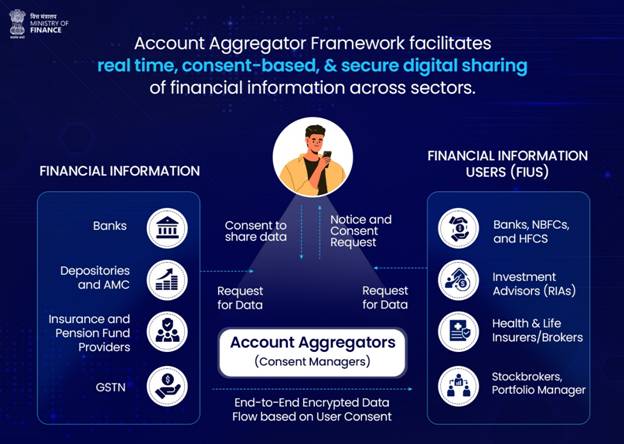
An Account Aggregator, or AA, is a consent-based data-sharing framework regulated by the RBI. It allows you, the customer, to share your financial data across institutions, with your explicit consent, in real time.
Think about what that actually means. Your salary account is in HDFC. Your investments are on Zerodha. Your insurance is with Tata AIG or HDFC Ergo. Your PPF is in SBI. Your credit card is with Axis. Today, none of these institutions can see each other. They operate in silos. You, the customer, are the common thread, but even you cannot get a single view of your own financial life without logging into five different apps, downloading ten different statements, and manually putting it all together.
Account Aggregators break those silos. With a single consent, your data can flow securely across institutions. You get a complete picture of where you stand financially. And more importantly, the apps and services built on top of the AA framework can use that data to actually help you, not just sell you more products.
The numbers speak for themselves
In three years, the AA framework crossed 100 million consents. In FY 2023-24 alone, consent requests grew by 1,059%. That is not a typo. One thousand and fifty-nine percent growth in a single financial year. Sahamati, the industry alliance that governs the AA ecosystem, estimates that 80-90 million Indians are already using the framework. That is 8% of India’s adult population, and they were projecting 25% penetration by end of 2025 (the realtime data is not available and we will update as sahamati or RBI announce the same). The AA ecosystem is now officially the largest and fastest-growing Open Finance ecosystem in the world.
This is Jan Dhan moment. This is UPI moment. Except most people haven’t noticed yet.
Why this is bigger than UPI
UPI solved payments. Account Aggregators solve financial awareness, access, and intelligence.
Think about what becomes possible when your entire financial picture – your income, expenses, investments, debts, insurance, tax records – is available in one place, with your consent. Banks can underwrite loans in minutes instead of weeks, without you physically submitting documents. Insurance companies can offer you policies priced accurately for your actual risk profile. Investment advisors can give you advice based on your real financial position, not just a form you filled out. And personal finance apps – apps like what we are building at Finanjo – can actually tell you where your money is going, what you can save, and how to grow it.
Today, the primary use case driving AA adoption is credit underwriting. Lenders love AA because it gives them verified, real-time bank statement data without any human intervention. That alone is a massive unlock for financial inclusion. India has 800 million underbanked people. Many of them have income but no formal credit history. AA changes that equation. Your cash flows become your credit score.
But credit is just the beginning. The use cases are expanding into personal finance management, portfolio monitoring, insurance issuance, early warning systems for loan defaults, and tax filing. Every financial service you can imagine is going to be rebuilt on top of this infrastructure.
The consent layer changes everything
Here is what makes AA fundamentally different from the data free-for-all that has defined global fintech.
Your data cannot be shared without your explicit, granular consent. You decide what data is shared, with whom, and for how long. You can revoke consent at any time. Unlike the West, where Open Banking typically leaves consent management to the Financial Information Users – meaning the apps and companies that benefit from your data – in India, Account Aggregators are independent consent managers. They have no financial interest in your data. They are simply the pipe. The infrastructure. The trusted third party.
This is a radically different model. And it matters. Because it means the AA ecosystem is built on user trust from day one. That trust is what will drive adoption. And adoption is what will unlock the full potential of this infrastructure.
The app layer is where the real opportunity lies
The AA framework is like the highway. What matters is what you build on top of it.
Right now, the primary beneficiaries of AA are banks and lenders. They are the biggest FIUs – Financial Information Users. But the real transformation will happen when consumer-facing apps use this data to genuinely improve the financial lives of ordinary Indians.
Imagine an app that connects all your accounts through AA, shows you exactly where your money went last month, flags subscriptions you forgot about, tells you how much you can realistically save given your income and expenses, and automatically recommends the right investment based on your actual financial position – not a generic risk profile. That is not science fiction. That is what becomes possible today with the AA framework.
The current generation of financial apps has failed Indians. They are glorified payment tools or credit pushers. They optimise for engagement and transaction volume. They are not built to make you financially disciplined. AA changes the incentive structure because when apps are built on consented, verified data, the value they can provide is so much deeper than anything possible before.
We have been here before
Every major infrastructure innovation in India has faced the same arc. Skepticism, then slow adoption, then explosive growth, then it becomes invisible because it is so deeply embedded in daily life.
Jan Dhan was dismissed. UPI was laughed at. Aadhaar was called intrusive. GST was called impossible. And one by one, they became the plumbing of modern India.
Account Aggregators are next. The 100 million consents milestone is the UPI’s early days. The 1059% growth rate is the signal that the system is finding product-market fit. The expansion from credit underwriting into personal finance management is the proof that the use cases are real.
The question is not whether Account Aggregators will become mainstream. They will. The question is who will build the applications that bring this infrastructure to the 1.4 billion people who need it most.
The highway is built. Now it is time to drive.
We have seen this before.
In 2014, when the government launched the Jan Dhan Yojana, a lot of people dismissed it. Too ambitious. Too complex. India is not ready. And then, when UPI came along, certain politicians publicly laughed at it (search that clip from parliament on youtube). Who will use digital payments for a 10-rupee chai? Street vendors? Auto drivers? Come on.
Well, here we are.
India now processes the largest volume of real-time digital payments in the world. More than any other country. Not the US, not China. India. A country that, barely a decade ago, was still largely unbanked.
The same people who laughed at UPI are now using it every single day. That is the story of India’s fintech transformation. Every time a new infrastructure layer is built, people dismiss it. And then it quietly becomes the backbone of the economy.
Account Aggregators are that next layer.
Digital payments changed India. But it also created a new problem that nobody is talking about enough.
Money is now invisible. When you paid by cash, you felt it leave your hands. There was friction. That friction had a psychological function. It made you aware. Today, a tap on your phone and the money is gone. You don’t feel it. You don’t see it. And by the end of the month, you look at your bank account and wonder where it all went.
UPI made spending frictionless. That is a feature. But it is also, quietly, a bug.
Consumer spending in India is at an all-time high. Credit card defaults are rising. Buy Now Pay Later has become a debt trap for millions of young Indians who do not fully understand what they are signing up for. The fintech apps that sit on your phone – the ones backed by billions in VC money – are not designed to help you save. They are designed to make you spend. More transactions means more revenue. More credit disbursals means more fees. The incentive structure of the entire industry is working against the financial health of the average Indian.
This is the problem Account Aggregators are built to fix.
An Account Aggregator, or AA, is a consent-based data-sharing framework regulated by the RBI. It allows you, the customer, to share your financial data across institutions, with your explicit consent, in real time.
Think about what that actually means. Your salary account is in HDFC. Your investments are on Zerodha. Your insurance is with Tata AIG or HDFC Ergo. Your PPF is in SBI. Your credit card is with Axis. Today, none of these institutions can see each other. They operate in silos. You, the customer, are the common thread, but even you cannot get a single view of your own financial life without logging into five different apps, downloading ten different statements, and manually putting it all together.
Account Aggregators break those silos. With a single consent, your data can flow securely across institutions. You get a complete picture of where you stand financially. And more importantly, the apps and services built on top of the AA framework can use that data to actually help you, not just sell you more products.
The numbers speak for themselves
In three years, the AA framework crossed 100 million consents. In FY 2023-24 alone, consent requests grew by 1,059%. That is not a typo. One thousand and fifty-nine percent growth in a single financial year. Sahamati, the industry alliance that governs the AA ecosystem, estimates that 80-90 million Indians are already using the framework. That is 8% of India’s adult population, and they were projecting 25% penetration by end of 2025 (the realtime data is not available and we will update as sahamati or RBI announce the same). The AA ecosystem is now officially the largest and fastest-growing Open Finance ecosystem in the world.
This is Jan Dhan moment. This is UPI moment. Except most people haven’t noticed yet.
Why this is bigger than UPI
UPI solved payments. Account Aggregators solve financial awareness, access, and intelligence.
Think about what becomes possible when your entire financial picture – your income, expenses, investments, debts, insurance, tax records – is available in one place, with your consent. Banks can underwrite loans in minutes instead of weeks, without you physically submitting documents. Insurance companies can offer you policies priced accurately for your actual risk profile. Investment advisors can give you advice based on your real financial position, not just a form you filled out. And personal finance apps – apps like what we are building at Finanjo – can actually tell you where your money is going, what you can save, and how to grow it.
Today, the primary use case driving AA adoption is credit underwriting. Lenders love AA because it gives them verified, real-time bank statement data without any human intervention. That alone is a massive unlock for financial inclusion. India has 800 million underbanked people. Many of them have income but no formal credit history. AA changes that equation. Your cash flows become your credit score.
But credit is just the beginning. The use cases are expanding into personal finance management, portfolio monitoring, insurance issuance, early warning systems for loan defaults, and tax filing. Every financial service you can imagine is going to be rebuilt on top of this infrastructure.
The consent layer changes everything
Here is what makes AA fundamentally different from the data free-for-all that has defined global fintech.
Your data cannot be shared without your explicit, granular consent. You decide what data is shared, with whom, and for how long. You can revoke consent at any time. Unlike the West, where Open Banking typically leaves consent management to the Financial Information Users – meaning the apps and companies that benefit from your data – in India, Account Aggregators are independent consent managers. They have no financial interest in your data. They are simply the pipe. The infrastructure. The trusted third party.
This is a radically different model. And it matters. Because it means the AA ecosystem is built on user trust from day one. That trust is what will drive adoption. And adoption is what will unlock the full potential of this infrastructure.
The app layer is where the real opportunity lies
The AA framework is like the highway. What matters is what you build on top of it.
Right now, the primary beneficiaries of AA are banks and lenders. They are the biggest FIUs – Financial Information Users. But the real transformation will happen when consumer-facing apps use this data to genuinely improve the financial lives of ordinary Indians.
Imagine an app that connects all your accounts through AA, shows you exactly where your money went last month, flags subscriptions you forgot about, tells you how much you can realistically save given your income and expenses, and automatically recommends the right investment based on your actual financial position – not a generic risk profile. That is not science fiction. That is what becomes possible today with the AA framework.
The current generation of financial apps has failed Indians. They are glorified payment tools or credit pushers. They optimise for engagement and transaction volume. They are not built to make you financially disciplined. AA changes the incentive structure because when apps are built on consented, verified data, the value they can provide is so much deeper than anything possible before.
We have been here before
Every major infrastructure innovation in India has faced the same arc. Skepticism, then slow adoption, then explosive growth, then it becomes invisible because it is so deeply embedded in daily life.
Jan Dhan was dismissed. UPI was laughed at. Aadhaar was called intrusive. GST was called impossible. And one by one, they became the plumbing of modern India.
Account Aggregators are next. The 100 million consents milestone is the UPI’s early days. The 1059% growth rate is the signal that the system is finding product-market fit. The expansion from credit underwriting into personal finance management is the proof that the use cases are real.
The question is not whether Account Aggregators will become mainstream. They will. The question is who will build the applications that bring this infrastructure to the 1.4 billion people who need it most.
The highway is built. Now it is time to drive.

