I read a lot of investor reports. Most of them describe problems I already know and solutions that remain safely abstract.
We had a call with Blume earlier this week and it reminded me of a report that was authored by Joseph, who was in the same call. So, I read it again. The report/commentary is titled, “AI: The Next Frontier of Personalisation in Finance” – and it was different. Not because it was surprising. Because it described, almost line for line, why we built Finanjo.
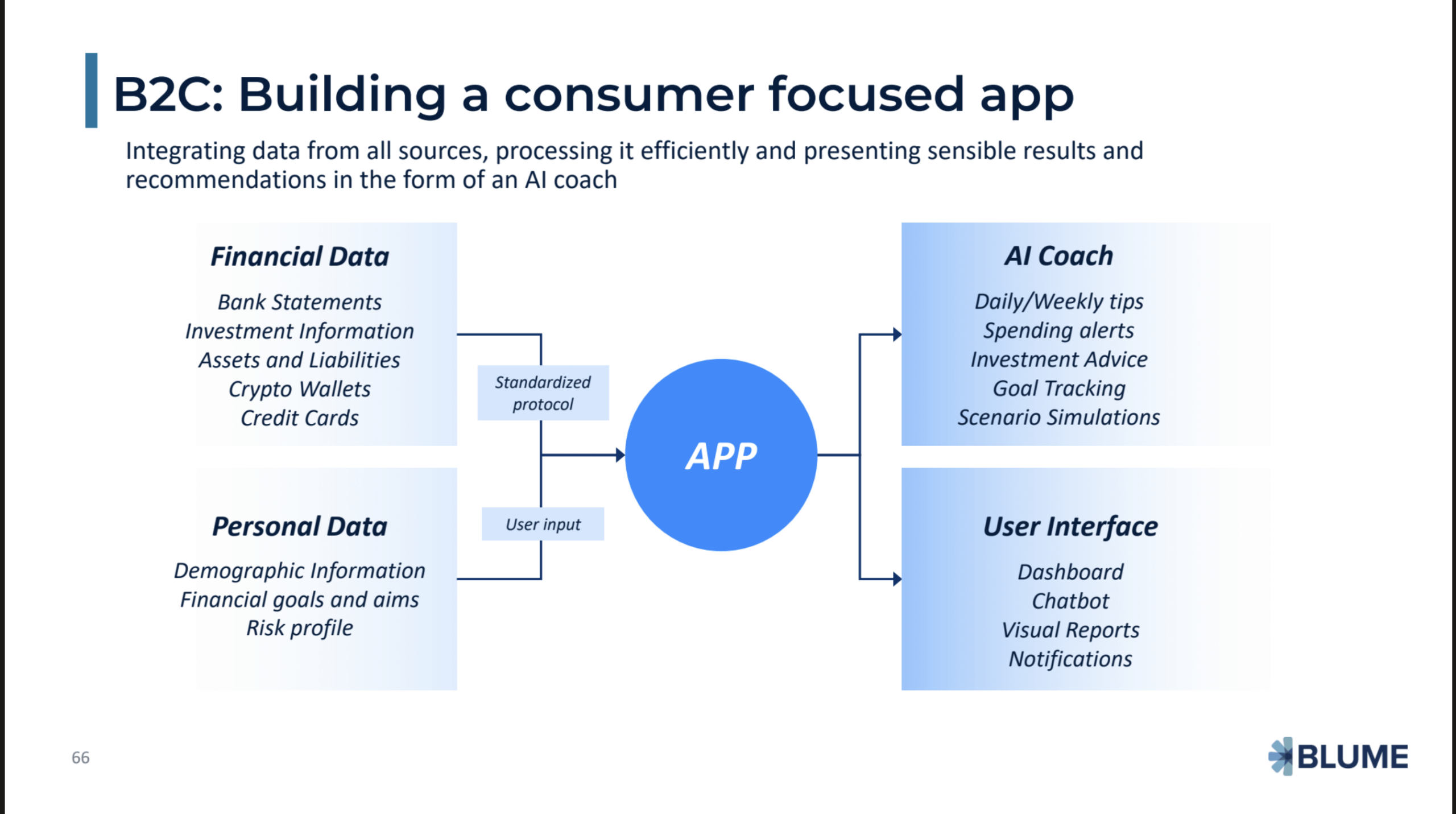
Blume’s Joseph Sebastian opens with a question that’s been sitting in my head since I came back from three years in London: the question is no longer if we’ll trust AI with our money – it’s when. But to understand why that question matters so much in India specifically, you have to understand the scale of the problem it’s answering.
The diagnosis
Here’s what Blume found when they looked at India’s personal finance landscape beneath the surface-level success story of UPI and Aadhaar:
Only 35% of Indian adults understand the basics of saving, borrowing, and investing. And there are fewer than 1,000 registered investment advisors serving 1.4 billion people – half of them sitting in four cities.
Read that again. Four cities.
For the software engineer in Indore who just got her first 8-lakh salary. For the small business owner in Rajkot watching his margin shrink and wondering if he should have more savings. For the 26-year-old in Jaipur who opened a demat account because everyone was talking about the markets but has no idea if his portfolio makes sense for his life.
There is no one coming to help them. And as Blume puts it – into this vacuum has rushed a tide of mis-selling.
This is the India I came back to. Not the India of the fintech glossy decks with UPI transaction charts. The India where 90% of retail investors take financial advice from friends and family, where less than 2% of households have ever spoken to a formal financial advisor, and where most people have a vague, anxious relationship with money – not because they’re irresponsible, but because no one has ever actually guided them.
The gap between access and outcomes
Blume’s Part II report on intelligent finance makes a point I think is underappreciated in this industry: “Financial outcomes are behavioral, not informational.”
India got very good at financial access. UPI moved money. Aadhaar onboarded people. Account Aggregators promised to connect the data. But access without guidance is a library without a librarian. You’re surrounded by information you don’t know how to use.
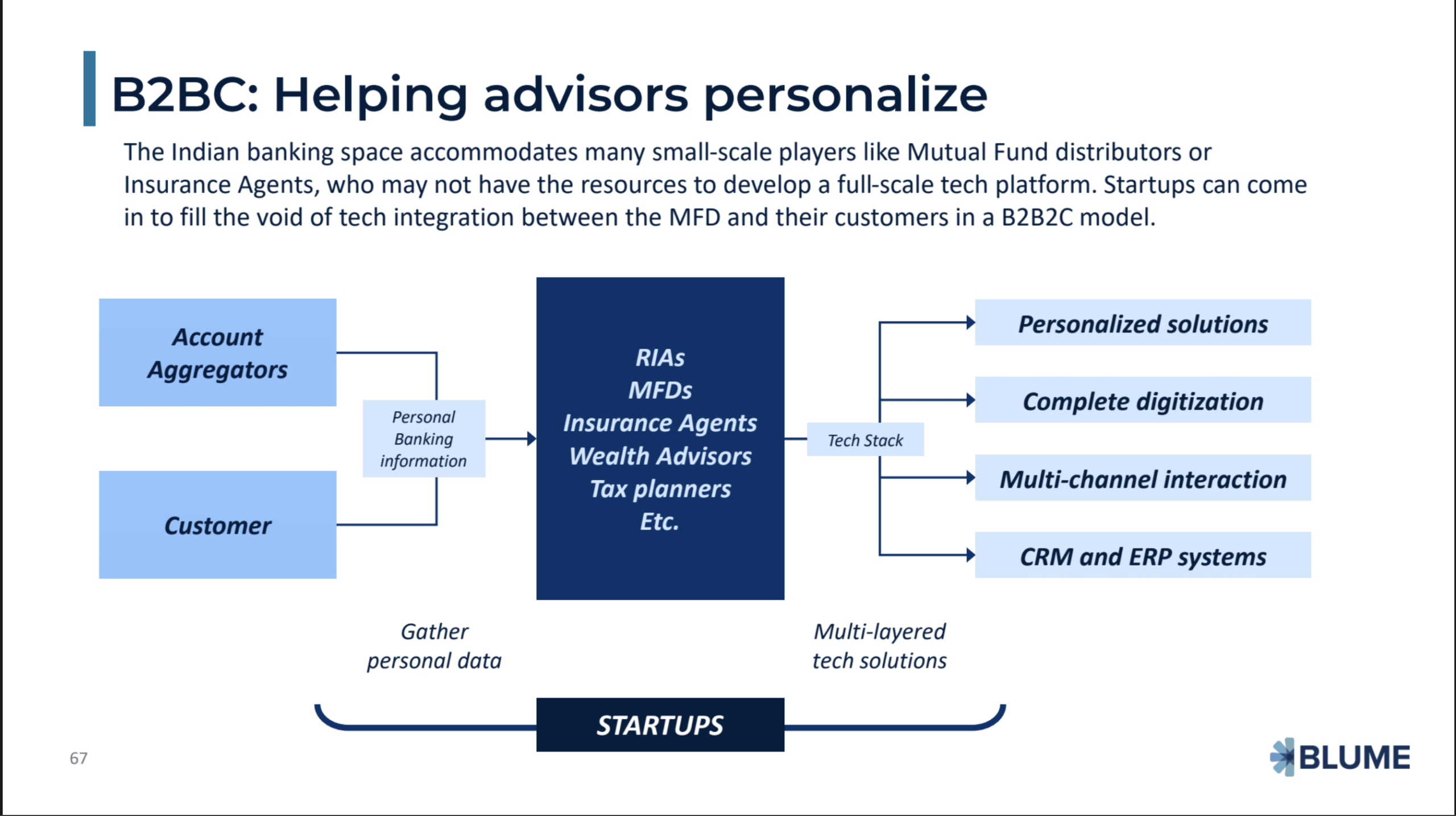
As Blume frames it: “Access is no longer the problem. Decision-making is. Users are inside the system – but alone with dashboards, choices, and risk.”
That sentence is a brief for what’s broken with most personal finance products today. They’re dashboards. They show you your data. They don’t tell you what to do with it.
I watched this differently from London. Living in Europe from 2022 to 2025, I saw how apps like Cleo, Monzo and Moneybox were designed around behaviour, not data. Cleo made an interface that seemed like your money was talking to you. Monzo didn’t just show you your spending – it built a subtle system of pots and nudges that changed how you related to your money. Moneybox rounded up every transaction and turned the spare change into investments. These weren’t information products. They were habit products.
India had better infrastructure. But nobody was using it to build that kind of companion.
What we built
That’s why Finanjo exists.
We’re built entirely on India’s Account Aggregator framework – because a real financial companion needs to see your real financial life. Not a PDF you uploaded. Not a screenshot of your portfolio. Your actual salary credits, your actual spending, your actual SIP deductions, your actual loan balance – all in one consented, real-time view.
On top of that, we built Jo. Jo is Finanjo’s AI companion. Not a chatbot that tells you what a mutual fund is. A system that reads your complete financial picture and tells you, clearly and honestly, whether you’re on track – and what to change if you’re not. No commissions.
No hidden agenda. No jargon.
Jo is what Blume describes as the shift from “access to outcomes, from products to systems.” It’s not a dashboard. It’s a guide.
We’ve built this for the 5,000+ users currently on the platform – young Indians who’ve connected ₹40 crore of savings and are using Jo to close the gap between where they are and where they want to be. We’re building it for the hundreds of millions who don’t yet have anyone in their corner.
The question Blume asks
Joseph’s piece ends with this:
“The rails are built. The AI is ready. The need is undeniable. The question now is: who will build the companion that India can trust with its financial future?”
We’re working on the answer. Every day.
If you’re a young Indian who’s done the hard work of earning money but hasn’t found something that actually helps you do more with it – try Finanjo.
The guide is here.
I read a lot of investor reports. Most of them describe problems I already know and solutions that remain safely abstract.
We had a call with Blume earlier this week and it reminded me of a report that was authored by Joseph, who was in the same call. So, I read it again. The report/commentary is titled, “AI: The Next Frontier of Personalisation in Finance” – and it was different. Not because it was surprising. Because it described, almost line for line, why we built Finanjo.
Blume’s Joseph Sebastian opens with a question that’s been sitting in my head since I came back from three years in London: the question is no longer if we’ll trust AI with our money – it’s when. But to understand why that question matters so much in India specifically, you have to understand the scale of the problem it’s answering.
The diagnosis
Here’s what Blume found when they looked at India’s personal finance landscape beneath the surface-level success story of UPI and Aadhaar:
Only 35% of Indian adults understand the basics of saving, borrowing, and investing. And there are fewer than 1,000 registered investment advisors serving 1.4 billion people – half of them sitting in four cities.
Read that again. Four cities.
For the software engineer in Indore who just got her first 8-lakh salary. For the small business owner in Rajkot watching his margin shrink and wondering if he should have more savings. For the 26-year-old in Jaipur who opened a demat account because everyone was talking about the markets but has no idea if his portfolio makes sense for his life.
There is no one coming to help them. And as Blume puts it – into this vacuum has rushed a tide of mis-selling.
This is the India I came back to. Not the India of the fintech glossy decks with UPI transaction charts. The India where 90% of retail investors take financial advice from friends and family, where less than 2% of households have ever spoken to a formal financial advisor, and where most people have a vague, anxious relationship with money – not because they’re irresponsible, but because no one has ever actually guided them.
The gap between access and outcomes
Blume’s Part II report on intelligent finance makes a point I think is underappreciated in this industry: “Financial outcomes are behavioral, not informational.”
India got very good at financial access. UPI moved money. Aadhaar onboarded people. Account Aggregators promised to connect the data. But access without guidance is a library without a librarian. You’re surrounded by information you don’t know how to use.
As Blume frames it: “Access is no longer the problem. Decision-making is. Users are inside the system – but alone with dashboards, choices, and risk.”
That sentence is a brief for what’s broken with most personal finance products today. They’re dashboards. They show you your data. They don’t tell you what to do with it.
I watched this differently from London. Living in Europe from 2022 to 2025, I saw how apps like Cleo, Monzo and Moneybox were designed around behaviour, not data. Cleo made an interface that seemed like your money was talking to you. Monzo didn’t just show you your spending – it built a subtle system of pots and nudges that changed how you related to your money. Moneybox rounded up every transaction and turned the spare change into investments. These weren’t information products. They were habit products.
India had better infrastructure. But nobody was using it to build that kind of companion.
What we built
That’s why Finanjo exists.
We’re built entirely on India’s Account Aggregator framework – because a real financial companion needs to see your real financial life. Not a PDF you uploaded. Not a screenshot of your portfolio. Your actual salary credits, your actual spending, your actual SIP deductions, your actual loan balance – all in one consented, real-time view.
On top of that, we built Jo. Jo is Finanjo’s AI companion. Not a chatbot that tells you what a mutual fund is. A system that reads your complete financial picture and tells you, clearly and honestly, whether you’re on track – and what to change if you’re not. No commissions.
No hidden agenda. No jargon.
Jo is what Blume describes as the shift from “access to outcomes, from products to systems.” It’s not a dashboard. It’s a guide.
We’ve built this for the 5,000+ users currently on the platform – young Indians who’ve connected ₹40 crore of savings and are using Jo to close the gap between where they are and where they want to be. We’re building it for the hundreds of millions who don’t yet have anyone in their corner.
The question Blume asks
Joseph’s piece ends with this:
“The rails are built. The AI is ready. The need is undeniable. The question now is: who will build the companion that India can trust with its financial future?”
We’re working on the answer. Every day.
If you’re a young Indian who’s done the hard work of earning money but hasn’t found something that actually helps you do more with it – try Finanjo.
The guide is here.

