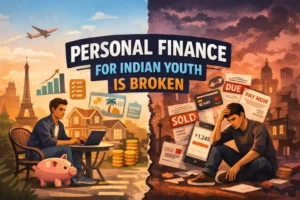
Between 2022 and 2025, I lived across Europe. I first moved to Stockholm for an international business law specialisation at Stockholm University, later to London for a master’s in international financial law at King’s College London, and briefly worked at HSBC Bank. Along the way, I travelled across multiple European countries and cities, interacting closely with students, young professionals, and early-career founders.
What struck me was not higher income or better jobs. It was financial clarity and control at a surprisingly young age.
I knew teenagers saving intentionally for college. Students in their early twenties working part-time while planning travel months in advance. Young professionals owning homes or at least knowing exactly when they could afford one. Weekend plans, holidays, and even career decisions were made with a clear understanding of money, trade-offs, and consequences.
Contrary to the Indian belief, Europe is not financially perfect. Taxes are high, growth is slower, and many mistakes are cushioned by strong welfare systems. But one thing is undeniably better: financial decision-making starts early, and it is structured.
This clarity was not accidental. It was not just culture or discipline. It was systems.
Sweden, which has been working towards becoming one of the world’s first cashless economies, and London, the financial capital of the world, both shared a common pattern. The financial apps people used were not passive dashboards. They did not merely show balances, expenses, or charts. They actively guided decisions.
These systems told users where they stood, what was coming next, and what action made sense now. Money was not something to be manually managed every month. It was something that quietly organised itself around real life.
That distinction matters more than we realise.
In India, personal finance has largely evolved as an information problem. We have apps that show balances, list expenses, calculate credit scores, and display portfolio graphs. But knowing is not the same as deciding. And insight without action is just noise.
Despite rising incomes and improving standards of living, young Indians struggle to save, plan, and compound wealth. Salaries hit accounts, sit idle for a few days, and then disappear into EMIs, subscriptions, impulsive spending, and poorly timed decisions. Credit is easy to access, but difficult to understand. Cash is abundant in fragments, but rarely intentional.
We often romanticise the “European lifestyle”. The idea that people can work for ten months and travel the world for the remaining two. But that lifestyle is not a function of higher income. It is a function of predictable finances. When people know exactly what money is free, for how long, and at what cost, they plan boldly and act calmly.
In India, most young professionals cannot answer three basic questions with confidence:
This is not a discipline problem. It is a system problem.
Personal finance in India is fragmented, reactive, and overly manual. We expect individuals to behave like finance professionals in a system that offers them little real-time guidance. The result is stress, inefficiency, and lost opportunity, quietly accumulating month after month.
This gap between information and action is what needs fixing. And it is the gap Finanjo is built to address.
More in my next posts..
Between 2022 and 2025, I lived across Europe. I first moved to Stockholm for an international business law specialisation at Stockholm University, later to London for a master’s in international financial law at King’s College London, and briefly worked at HSBC Bank. Along the way, I travelled across multiple European countries and cities, interacting closely with students, young professionals, and early-career founders.
What struck me was not higher income or better jobs. It was financial clarity and control at a surprisingly young age.
I knew teenagers saving intentionally for college. Students in their early twenties working part-time while planning travel months in advance. Young professionals owning homes or at least knowing exactly when they could afford one. Weekend plans, holidays, and even career decisions were made with a clear understanding of money, trade-offs, and consequences.
Contrary to the Indian belief, Europe is not financially perfect. Taxes are high, growth is slower, and many mistakes are cushioned by strong welfare systems. But one thing is undeniably better: financial decision-making starts early, and it is structured.
This clarity was not accidental. It was not just culture or discipline. It was systems.
Sweden, which has been working towards becoming one of the world’s first cashless economies, and London, the financial capital of the world, both shared a common pattern. The financial apps people used were not passive dashboards. They did not merely show balances, expenses, or charts. They actively guided decisions.
These systems told users where they stood, what was coming next, and what action made sense now. Money was not something to be manually managed every month. It was something that quietly organised itself around real life.
That distinction matters more than we realise.
In India, personal finance has largely evolved as an information problem. We have apps that show balances, list expenses, calculate credit scores, and display portfolio graphs. But knowing is not the same as deciding. And insight without action is just noise.
Despite rising incomes and improving standards of living, young Indians struggle to save, plan, and compound wealth. Salaries hit accounts, sit idle for a few days, and then disappear into EMIs, subscriptions, impulsive spending, and poorly timed decisions. Credit is easy to access, but difficult to understand. Cash is abundant in fragments, but rarely intentional.
We often romanticise the “European lifestyle”. The idea that people can work for ten months and travel the world for the remaining two. But that lifestyle is not a function of higher income. It is a function of predictable finances. When people know exactly what money is free, for how long, and at what cost, they plan boldly and act calmly.
In India, most young professionals cannot answer three basic questions with confidence:
This is not a discipline problem. It is a system problem.
Personal finance in India is fragmented, reactive, and overly manual. We expect individuals to behave like finance professionals in a system that offers them little real-time guidance. The result is stress, inefficiency, and lost opportunity, quietly accumulating month after month.
This gap between information and action is what needs fixing. And it is the gap Finanjo is built to address.
More in my next posts..

