The Public Provident Fund (PPF) is one of India’s most trusted long-term savings schemes, backed by the Government of India. Designed to encourage disciplined savings, PPF offers a unique combination of capital safety, assured returns, and powerful tax benefits, making it a popular choice among conservative and long-term investors.
EEE investments are those where the investment amount, the interest earned, and the maturity proceeds are all completely exempt from tax under the Income Tax Act. Such investments are rare, which is why PPF is often considered one of the most efficient tax-saving instruments in India.
In this blog, we will explain how PPF is an EEE investment, break down its tax benefits at each stage, and help you understand why PPF continues to be a preferred choice for building tax-free, long-term wealth.
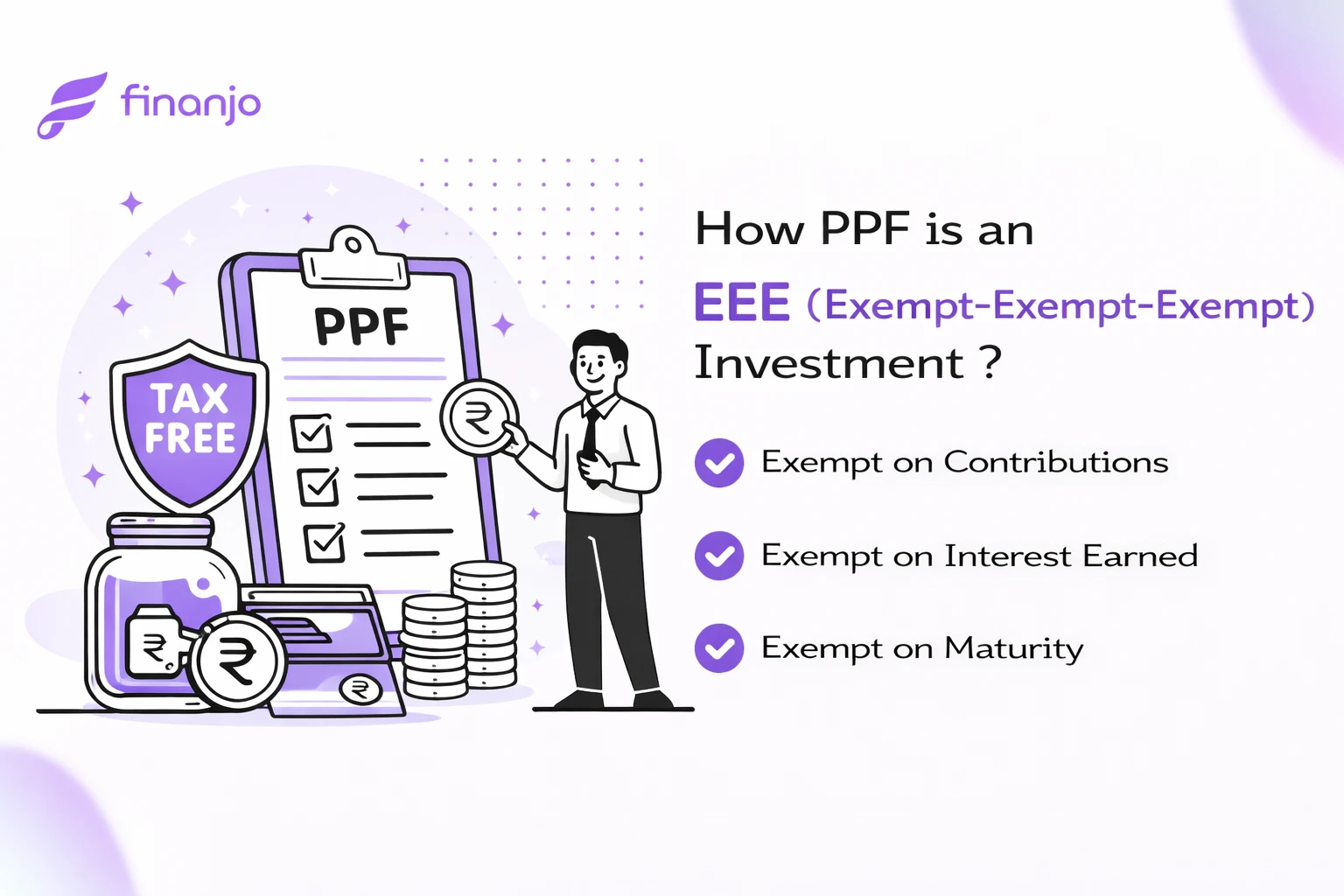
| Stage | What Happens | Tax Treatment | Benefit |
|---|---|---|---|
| Exempt #1: Investment | You invest up to ₹1.5 lakh per year in PPF | Eligible for deduction under Section 80C | Saves tax right away |
| Exempt #2: Interest Earned | Government declares interest (currently ~7.1% p.a.) | Interest is tax-free (unlike FDs) | Wealth grows without tax cuts |
| Exempt #3: Maturity Amount | After 15 years, you withdraw full amount | Entire withdrawal is 100% tax-free | Keeps your final corpus safe |
In taxation, investment products are often classified based on how they are taxed at different stages. One of the most beneficial classifications is EEE, which stands for Exempt–Exempt–Exempt.
An investment is called EEE when it enjoys tax exemption at all three stages:
1. Exempt at the time of investment
The amount you invest is eligible for tax deduction, usually under Section 80C of the Income Tax Act.
2. Exempt on interest or returns
Any interest earned or returns generated during the investment period are completely tax-free, with no annual tax liability.
3. Exempt at maturity or withdrawal
The final amount you receive at maturity or withdrawal is fully exempt from tax, with no TDS or capital gains tax.
Because there is no tax impact at any stage, EEE investments allow your money to grow without tax erosion, leading to better long-term wealth creation.
| Tax Structure | Investment Stage | Interest/Returns | Maturity Stage | Example |
|---|---|---|---|---|
| EEE | Exempt | Exempt | Exempt | PPF |
| EET | Exempt | Exempt | Taxable | NPS |
| ETE | Exempt | Taxable | Exempt | Bank FD |
EEE investments are limited in India because they offer maximum tax relief to investors, which reduces tax collections for the government. To balance revenue and long-term savings goals, only a few government-backed schemes enjoy full EEE status.
This rarity makes EEE investments extremely valuable, especially for:
Public Provident Fund (PPF) is a government-backed long-term savings scheme introduced to encourage disciplined savings and provide tax-efficient returns. It is ideal for investors who prioritize capital safety, stable returns, and tax savings.
Investments can be made in lump sum or installments (up to 12 per year)
The invested amount qualifies for tax deduction under Section 80C, within the overall limit.
The PPF interest rate is decided and reviewed quarterly by the Government of India (7.10%* p.a {as of Q1 FY 2025-2026}).
The rate applicable is “as notified by the government”, and the interest earned is fully tax-free.
The Public Provident Fund (PPF) is classified as an EEE (Exempt–Exempt–Exempt) investment because it offers tax benefits at all three stages investment, interest earned, and maturity.
Tax Deduction under Section 80C
The amount invested in PPF is eligible for tax deduction under Section 80C of the Income Tax Act, 1961. This helps investors reduce their taxable income in the year of contribution.
Maximum Deduction Limit
Who Can Claim the Deduction?
This makes PPF an effective tool for immediate tax saving while building long-term wealth.
PPF Interest is Fully Tax-Free
The interest earned on PPF investments is completely exempt from tax, regardless of the amount.
No Annual Tax Liability
Unlike fixed deposits or other interest-bearing instruments, PPF interest:
Power of Compounding Without Tax Erosion
Since no tax is deducted on interest each year, the entire interest amount gets reinvested. This allows investors to enjoy the full power of compounding, leading to significantly higher tax-free returns over the long term.
Maturity Amount is 100% Tax-Free
The total amount received at maturity principal plus accumulated interest is completely exempt from tax.
No Tax on Withdrawals
Tax Treatment on Partial Withdrawals and Extensions
Because PPF provides:
To clearly understand how PPF works as an EEE investment, let’s look at a simple numerical example and compare it with a taxable investment like a bank fixed deposit (FD).
Assumptions:
Over 15 years, the investor saves a significant amount in income tax just by investing in PPF.
In a taxable investment, this interest would be taxed every year, reducing the effective return.
The investor receives the full maturity value without any deduction.
| Particulars | PPF (EEE) | Bank Fixed Deposit |
|---|---|---|
| Investment deduction | Yes (80C) | No |
| Interest tax | Fully tax-free | Taxable every year |
| TDS on interest | No | Yes (above limit) |
| Maturity amount | Fully tax-free | Taxable |
| Compounding benefit | Full | Reduced due to tax |
While there are several tax-saving investment options available in India, each differs in terms of risk, returns, liquidity, and tax treatment.
| Feature | PPF | Tax-Saving FD |
|---|---|---|
| Tax benefit on investment | Yes (Section 80C) | Yes (Section 80C) |
| Interest taxability | Fully tax-free | Fully taxable |
| Lock-in period | 15 years | 5 years |
| Risk level | Very low (government-backed) | Low |
| Maturity amount | Tax-free | Taxable |
Why PPF is better:
Although both qualify for Section 80C, FD interest is taxed every year, which lowers actual returns. PPF’s tax-free interest and maturity make it more efficient in the long run.
| Feature | PPF | ELSS Mutual Funds |
|---|---|---|
| Market risk | No | Yes |
| Lock-in period | 15 years | 3 years |
| Returns | Stable | Market-linked (higher potential) |
| Tax on returns | Tax-free | Long-term capital gains tax |
| Capital safety | Guaranteed | Not guaranteed |
Which is better?
| Feature | PPF | NPS |
|---|---|---|
| Tax status | EEE | EET |
| Investment deduction | Section 80C | 80C + additional benefit |
| Interest taxability | Tax-free | Tax-free during accumulation |
| Tax at withdrawal | No | Partial taxation |
| Liquidity | Limited | Very limited till retirement |
Key difference:
NPS follows an EET structure, meaning withdrawals are partly taxable at retirement, whereas PPF remains fully tax-free even at maturity.
PPF is especially suitable for investors who:
Beyond its EEE status, the Public Provident Fund (PPF) offers several additional advantages that strengthen its appeal as a long-term, tax-efficient investment.
PPF interest does not attract Tax Deducted at Source (TDS). Investors receive the entire interest amount without any deductions, and there is no need to worry about yearly tax compliance related to PPF interest.
PPF is a government-backed scheme and is completely insulated from stock market ups and downs. This makes it a reliable option during economic uncertainty and market corrections.
The balance in a PPF account cannot be attached by courts or creditors to recover debts. This legal protection adds an extra layer of financial security for investors.
With a 15-year tenure and extension options, PPF is well-suited for:
PPF is not for everyone, but it is perfectly suited for certain investor profiles:
While PPF has many advantages, it also comes with a few limitations that investors should be aware of:
Let’s say you invest ₹1.5 lakh per year in PPF for 15 years.
If the same money were invested in an FD at 7% interest, you would lose 10–30% of your interest as tax each year. Over 15 years, this makes a huge difference.
You can claim up to ₹1.5 lakh under Section 80C, which means a maximum saving of ₹46,800 if you fall in the highest 30% tax bracket.
Yes. As per current income tax rules, the entire interest is exempt from tax.
PPF enjoys special protection, and historically, the EEE status has never been withdrawn. It’s one of the safest bets for tax-free savings.
No. NRIs cannot open a new PPF account. However, if they already had one before becoming NRI, they can continue until maturity and enjoy tax-free status.
EEE means Exempt–Exempt–Exempt. Your investment amount, the interest earned, and the maturity proceeds are all completely tax-free.
PPF tax benefits under Section 80C are available only under the old tax regime. Under the new tax regime, deductions are not allowed, but PPF interest and maturity remain tax-free.
Yes. Even though it is tax-free, the maturity amount should be reported in the exempt income section while filing your income tax return.
Yes. Partial withdrawals from a PPF account are completely tax-free and do not attract any tax liability.
No. Taking a loan against your PPF does not impact its EEE status. The interest earned and maturity amount remain tax-free.
For long-term, risk-free, and tax-free savings, PPF stands out among 80C options. While returns may be moderate, the EEE benefit makes it extremely efficient for conservative investors.
The Public Provident Fund (PPF) is one of India’s most trusted long-term savings schemes, backed by the Government of India. Designed to encourage disciplined savings, PPF offers a unique combination of capital safety, assured returns, and powerful tax benefits, making it a popular choice among conservative and long-term investors.
EEE investments are those where the investment amount, the interest earned, and the maturity proceeds are all completely exempt from tax under the Income Tax Act. Such investments are rare, which is why PPF is often considered one of the most efficient tax-saving instruments in India.
In this blog, we will explain how PPF is an EEE investment, break down its tax benefits at each stage, and help you understand why PPF continues to be a preferred choice for building tax-free, long-term wealth.
| Stage | What Happens | Tax Treatment | Benefit |
|---|---|---|---|
| Exempt #1: Investment | You invest up to ₹1.5 lakh per year in PPF | Eligible for deduction under Section 80C | Saves tax right away |
| Exempt #2: Interest Earned | Government declares interest (currently ~7.1% p.a.) | Interest is tax-free (unlike FDs) | Wealth grows without tax cuts |
| Exempt #3: Maturity Amount | After 15 years, you withdraw full amount | Entire withdrawal is 100% tax-free | Keeps your final corpus safe |
In taxation, investment products are often classified based on how they are taxed at different stages. One of the most beneficial classifications is EEE, which stands for Exempt–Exempt–Exempt.
An investment is called EEE when it enjoys tax exemption at all three stages:
1. Exempt at the time of investment
The amount you invest is eligible for tax deduction, usually under Section 80C of the Income Tax Act.
2. Exempt on interest or returns
Any interest earned or returns generated during the investment period are completely tax-free, with no annual tax liability.
3. Exempt at maturity or withdrawal
The final amount you receive at maturity or withdrawal is fully exempt from tax, with no TDS or capital gains tax.
Because there is no tax impact at any stage, EEE investments allow your money to grow without tax erosion, leading to better long-term wealth creation.
| Tax Structure | Investment Stage | Interest/Returns | Maturity Stage | Example |
|---|---|---|---|---|
| EEE | Exempt | Exempt | Exempt | PPF |
| EET | Exempt | Exempt | Taxable | NPS |
| ETE | Exempt | Taxable | Exempt | Bank FD |
EEE investments are limited in India because they offer maximum tax relief to investors, which reduces tax collections for the government. To balance revenue and long-term savings goals, only a few government-backed schemes enjoy full EEE status.
This rarity makes EEE investments extremely valuable, especially for:
Public Provident Fund (PPF) is a government-backed long-term savings scheme introduced to encourage disciplined savings and provide tax-efficient returns. It is ideal for investors who prioritize capital safety, stable returns, and tax savings.
Investments can be made in lump sum or installments (up to 12 per year)
The invested amount qualifies for tax deduction under Section 80C, within the overall limit.
The PPF interest rate is decided and reviewed quarterly by the Government of India (7.10%* p.a {as of Q1 FY 2025-2026}).
The rate applicable is “as notified by the government”, and the interest earned is fully tax-free.
The Public Provident Fund (PPF) is classified as an EEE (Exempt–Exempt–Exempt) investment because it offers tax benefits at all three stages investment, interest earned, and maturity.
Tax Deduction under Section 80C
The amount invested in PPF is eligible for tax deduction under Section 80C of the Income Tax Act, 1961. This helps investors reduce their taxable income in the year of contribution.
Maximum Deduction Limit
Who Can Claim the Deduction?
This makes PPF an effective tool for immediate tax saving while building long-term wealth.
PPF Interest is Fully Tax-Free
The interest earned on PPF investments is completely exempt from tax, regardless of the amount.
No Annual Tax Liability
Unlike fixed deposits or other interest-bearing instruments, PPF interest:
Power of Compounding Without Tax Erosion
Since no tax is deducted on interest each year, the entire interest amount gets reinvested. This allows investors to enjoy the full power of compounding, leading to significantly higher tax-free returns over the long term.
Maturity Amount is 100% Tax-Free
The total amount received at maturity principal plus accumulated interest is completely exempt from tax.
No Tax on Withdrawals
Tax Treatment on Partial Withdrawals and Extensions
Because PPF provides:
To clearly understand how PPF works as an EEE investment, let’s look at a simple numerical example and compare it with a taxable investment like a bank fixed deposit (FD).
Assumptions:
Over 15 years, the investor saves a significant amount in income tax just by investing in PPF.
In a taxable investment, this interest would be taxed every year, reducing the effective return.
The investor receives the full maturity value without any deduction.
| Particulars | PPF (EEE) | Bank Fixed Deposit |
|---|---|---|
| Investment deduction | Yes (80C) | No |
| Interest tax | Fully tax-free | Taxable every year |
| TDS on interest | No | Yes (above limit) |
| Maturity amount | Fully tax-free | Taxable |
| Compounding benefit | Full | Reduced due to tax |
While there are several tax-saving investment options available in India, each differs in terms of risk, returns, liquidity, and tax treatment.
| Feature | PPF | Tax-Saving FD |
|---|---|---|
| Tax benefit on investment | Yes (Section 80C) | Yes (Section 80C) |
| Interest taxability | Fully tax-free | Fully taxable |
| Lock-in period | 15 years | 5 years |
| Risk level | Very low (government-backed) | Low |
| Maturity amount | Tax-free | Taxable |
Why PPF is better:
Although both qualify for Section 80C, FD interest is taxed every year, which lowers actual returns. PPF’s tax-free interest and maturity make it more efficient in the long run.
| Feature | PPF | ELSS Mutual Funds |
|---|---|---|
| Market risk | No | Yes |
| Lock-in period | 15 years | 3 years |
| Returns | Stable | Market-linked (higher potential) |
| Tax on returns | Tax-free | Long-term capital gains tax |
| Capital safety | Guaranteed | Not guaranteed |
Which is better?
| Feature | PPF | NPS |
|---|---|---|
| Tax status | EEE | EET |
| Investment deduction | Section 80C | 80C + additional benefit |
| Interest taxability | Tax-free | Tax-free during accumulation |
| Tax at withdrawal | No | Partial taxation |
| Liquidity | Limited | Very limited till retirement |
Key difference:
NPS follows an EET structure, meaning withdrawals are partly taxable at retirement, whereas PPF remains fully tax-free even at maturity.
PPF is especially suitable for investors who:
Beyond its EEE status, the Public Provident Fund (PPF) offers several additional advantages that strengthen its appeal as a long-term, tax-efficient investment.
PPF interest does not attract Tax Deducted at Source (TDS). Investors receive the entire interest amount without any deductions, and there is no need to worry about yearly tax compliance related to PPF interest.
PPF is a government-backed scheme and is completely insulated from stock market ups and downs. This makes it a reliable option during economic uncertainty and market corrections.
The balance in a PPF account cannot be attached by courts or creditors to recover debts. This legal protection adds an extra layer of financial security for investors.
With a 15-year tenure and extension options, PPF is well-suited for:
PPF is not for everyone, but it is perfectly suited for certain investor profiles:
While PPF has many advantages, it also comes with a few limitations that investors should be aware of:
Let’s say you invest ₹1.5 lakh per year in PPF for 15 years.
If the same money were invested in an FD at 7% interest, you would lose 10–30% of your interest as tax each year. Over 15 years, this makes a huge difference.
You can claim up to ₹1.5 lakh under Section 80C, which means a maximum saving of ₹46,800 if you fall in the highest 30% tax bracket.
Yes. As per current income tax rules, the entire interest is exempt from tax.
PPF enjoys special protection, and historically, the EEE status has never been withdrawn. It’s one of the safest bets for tax-free savings.
No. NRIs cannot open a new PPF account. However, if they already had one before becoming NRI, they can continue until maturity and enjoy tax-free status.
EEE means Exempt–Exempt–Exempt. Your investment amount, the interest earned, and the maturity proceeds are all completely tax-free.
PPF tax benefits under Section 80C are available only under the old tax regime. Under the new tax regime, deductions are not allowed, but PPF interest and maturity remain tax-free.
Yes. Even though it is tax-free, the maturity amount should be reported in the exempt income section while filing your income tax return.
Yes. Partial withdrawals from a PPF account are completely tax-free and do not attract any tax liability.
No. Taking a loan against your PPF does not impact its EEE status. The interest earned and maturity amount remain tax-free.
For long-term, risk-free, and tax-free savings, PPF stands out among 80C options. While returns may be moderate, the EEE benefit makes it extremely efficient for conservative investors.
A contributor to the Finanjo blog, where I share insightful and easy-to-understand content focused on educating readers about finance. With a clear and approachable writing style, I simplify complex topics to make them more understandable.
A contributor to the Finanjo blog, where I share insightful and easy-to-understand content focused on educating readers about finance. With a clear and approachable writing style, I simplify complex topics to make them more understandable.

